
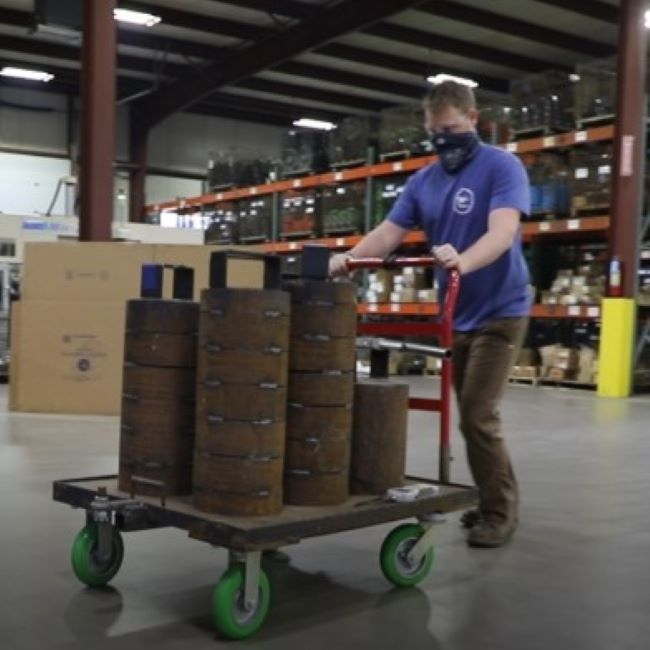

Overexertion injuries are the number one cause of workers’ compensation claims in industrial environments. And most of them are preventable.
The way employees move carts—how they push, pull, stop, and steer—directly impacts injury risk, productivity, and long-term workforce health. When movement isn’t engineered correctly, backs, shoulders, and joints pay the price.
The good news? Small changes in technique, equipment, and ergonomics can dramatically reduce strain, injuries, and downtime.
Let’s break down how to move wheeled carts the right way—safely, efficiently, and beyond standard.
RELATED: Why Choosing the Right Caster Improves Safety and Saves Money – Takeaways from Ergonomics Webinar.
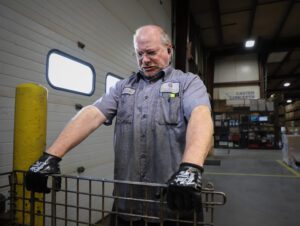
When given the choice, many workers instinctively pull a cart behind them. It feels easier in the moment—but it’s one of the fastest ways to invite injury.
Limited visibility: It’s harder to see where you are going when you are walking backward. This increases collision risk.
Higher shoulder and back strain: Pulling shifts the load to smaller muscle groups and puts undue stress on the shoulders and back. What’s more, the cart can keep rolling after you have stopped, which can cause it to collide into you.
Poor body mechanics: Pulling often twists the torso—one of the biggest contributors to lower back injuries.
Pushing a cart allows you to:
Maintain full visibility
Use body weight and leg strength instead of your lower back
Keep your spine in a neutral, safer position
Apply force more evenly and efficiently
Bottom line: Pushing distributes the load across stronger muscle groups and gives you better control—you are leaning your body into the cart and making the work easier by distributing more of the force of the weight, making it the safer, smarter choice.
1. Keep your hands just above waist level. This helps to better balance the center of gravity and significantly reduces injury risks. Carts with poorly positioned handles force workers to bend or shrug—both red flags for injury risk.
2. Always use both arms. Again, this helps evenly distribute the force needed to move the cart, reduces uneven muscle fatigue, and improves steering control. Uneven force leads to twisting. Twisting leads to injuries.
 3. Keep your back straight. A bent back is dangerous because it can strain muscles. Let your legs and core do the work. Neutral posture reduces compressive forces on the spine.
4. Engage your core. Contracting your stomach muscles helps strengthen and stabilize your core as you push, reducing back strain and helping to maintain balance during starts and stops. Strong core engagement turns pushing into a full-body movement—not a back injury waiting to happen.
5. Keep your body close to the cart. The further away you are from the cart, the more force you will need to exert to move it. Staying close allows you to use your body weight to your advantage and apply extra force without overexerting yourself.
6. Control your speed. Heavy carts should be moved very slowly; the heavier the load, the longer it will take for it to stop. Anticipate stopping distance and avoid sudden starts or stops. Momentum is manageable — until it isn’t.
7. Use high-quality casters that are appropriate for the load. Using the wrong casters can:
Increase rolling resistance
Require more push force
Amplify fatigue and overexertion
Increase injury risk over time
At Caster Concepts, we engineer casters not just to carry the load—but to reduce the physical demand on the people moving it.
These steps and tips are designed to ensure that you (or your employees) are moving loaded wheel carts appropriately to avoid injury. Knowing how to physically push the cart and ensuring that you have the right caster wheels for the job can save countless thousands of dollars, improve your production, and even improve employee morale.
If you’re ready to move beyond standard cart design and build a safer, more ergonomic operation, partner with Caster Concepts.
📞 Call 888.351.8453 to speak with a mobility expert and engineer a solution built for how your people actually work.